
How to Make Your Boardroom AI-Ready: A Strategic Framework for Executives
- Jan 24
- 3 min read

The organisations pulling ahead with AI share something in common, their leadership teams learned to think differently about how software is built.
The AI Landscape in 2025
Enterprise AI investment is accelerating. Thomson Reuters Institute research shows 82% of C-suite executives now rank digital transformation as a key goal, with 62% specifically prioritising AI implementation. Gartner predicts 33% of enterprise software will include agentic AI capabilities by 2028, up from less than 1% today.
The opportunity is real. McKinsey estimates generative AI could add USD $2.6–4.4 trillion (AED 9.5–16.2 trillion) annually to the global economy. Organisations that position themselves effectively stand to capture significant value.
Yet the research also reveals an interesting pattern. MIT's State of AI in Business 2025 report found that the organisations achieving measurable returns share specific characteristics, and they're not necessarily the ones with the biggest budgets or the most advanced technical teams. The differentiator lies in how leadership approaches AI strategy.
From Linear to Circular Thinking
For two decades, enterprise software followed a reliable pattern. Define requirements, build to specification, deploy, iterate. Frameworks like Amazon's Working Backwards and McKinsey's QuantumBlack 5Is served this linear world well.
But agentic AI operates differently.
Unlike traditional software executing predetermined instructions, AI agents reason, adapt, and act based on context. They're powered by Large Language Models (LLMs) that introduce probabilistic rather than deterministic behaviour. This creates new possibilities, but also requires a different strategic lens.
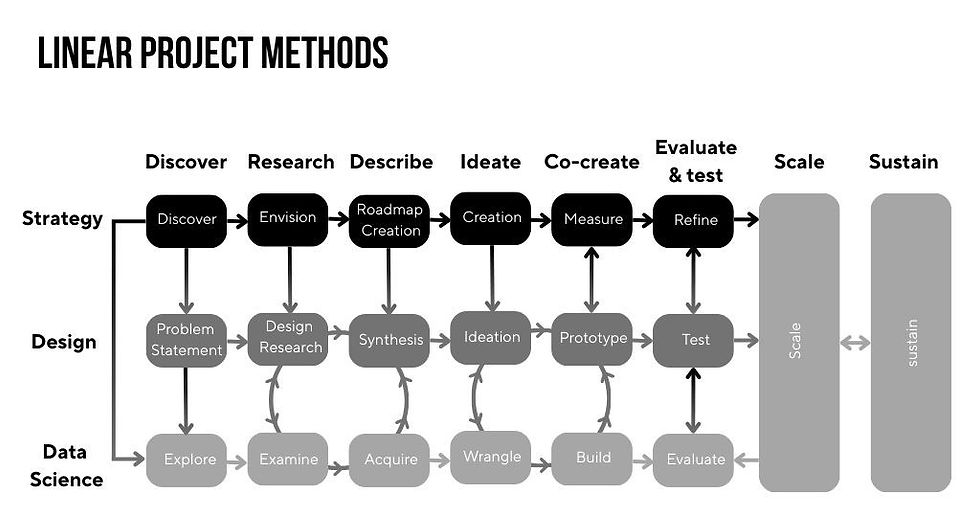
The executives leading successful AI initiatives have recognised this distinction. They've moved from asking "What's the specification?" to asking "How will this agent reason within our business context?”

The Strategic Framework - Five Phases of AI Integration
Organisations succeeding with agentic AI tend to follow a circular rather than linear approach. Here's the pattern:
Phase 1: Search Begin with business outcomes, not technology. Identify where AI agents could genuinely augment workforce capabilities, not replace them, but enhance decision-making speed and quality. The most effective leaders start by asking. "Where do our people spend time on tasks that don't require their unique expertise?"
Phase 2: Signals Map existing workflows to understand where value actually flows. The highest-impact opportunities often aren't the most obvious ones. MIT's research found that back-office automation consistently delivers stronger ROI than customer-facing applications, despite receiving less investment attention. Look for patterns in how information moves through your organisation.
Phase 3: Structure Create bounded environments to test AI integration against real operations. The concept of a "walled garden", controlled data access with clear governance, allows organisations to learn quickly while managing risk. This isn't about perfect systems; it's about creating safe spaces to experiment and iterate.
Phase 4: Shape Validate through actual workforce interaction, not theoretical projections. The organisations achieving returns measure success through real behavioural change, not projected efficiency gains. How are people actually using the tools? What's working? What isn't? This phase requires honest observation and rapid adjustment.
Phase 5: Ship Build repeatable patterns. The goal isn't a single successful pilot, it's developing organisational capability to identify, test, and scale AI opportunities continuously. The most successful organisations treat this as building a muscle, not completing a project.

The Questions to derisk, and look good
The shift to agentic AI introduces new considerations for executive teams. Leaders navigating this transition effectively tend to focus on questions like:
Governance: What decisions should remain human? Where does AI augment versus automate?
Integration: How do we connect AI capabilities to existing systems without creating technical debt?
Measurement: What does success actually look like—and how do we track it?
Talent: What new capabilities does our organisation need to develop?
McKinsey's 2025 research found that 89% of executives ranked AI as a top-three priority, while only 11% of employees felt "very prepared" to work with AI tools. This gap represents both a challenge and an opportunity, organisations that invest in building AI literacy across their teams create competitive advantage.
Looking Ahead
Gartner predicts 15% of day-to-day work decisions will be made autonomously through agentic AI by 2028. The executives who understand how these systems reason, and how to govern them effectively, will shape how that future unfolds within their organisations.
The strategic advantage goes to those who learn to think in circular patterns. Prototype early, validate quickly, iterate continuously. It's a different rhythm than traditional enterprise software, but it's one that can be learned.
What separates the organisations capturing value from those still experimenting? Typically, it comes down to leadership capability. When executive teams understand both the possibilities and the governance requirements of agentic AI, they make better decisions about where to invest, how to structure pilots, and when to scale.
The technology will continue evolving. The frameworks for thinking about it strategically will remain valuable.

Comments